
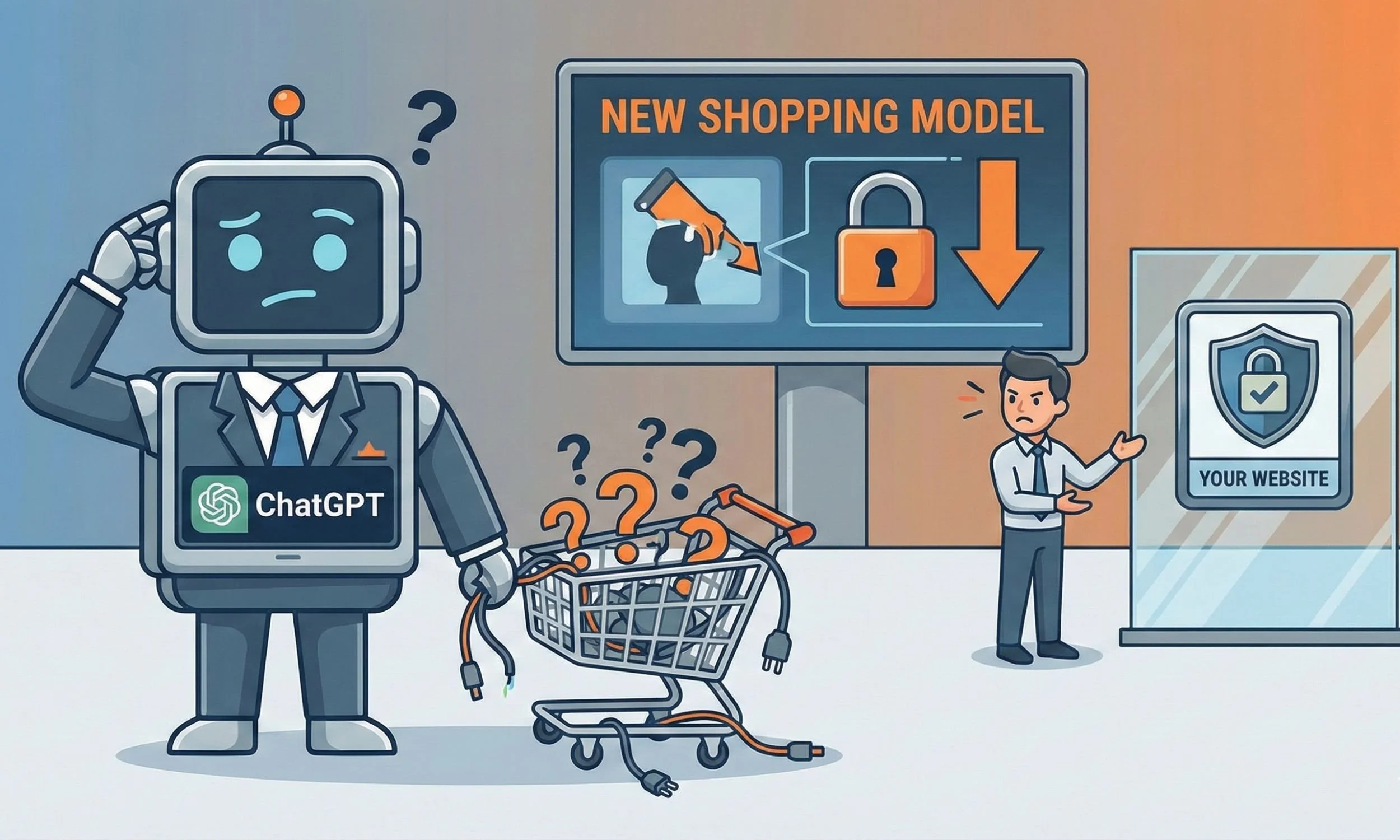
A few months ago, OpenAI announced its new feed-based shopping experience, and of course, for those of us working in e-commerce, this was extremely exciting.
At launch, the service required retailers (currently US only) to integrate their entire checkout flow directly into ChatGPT. In other words, instead of sending customers to a retailer’s website to complete a purchase, OpenAI expected brands to hand over the most sensitive, strategically important part of their funnel: the checkout.
They have since backtracked and state that if you don’t support agentic commerce, then the traffic will link out to your website. However, on the form to register interest, they ask twice if you’re going to integrate their checkout processes:
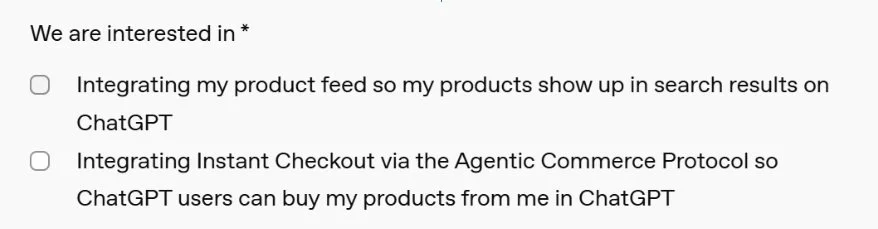

As someone who has worked in e-commerce and feed-based marketing for 20 years, the problems here are obvious.
Most retailers have minimal development capacity. Even seemingly simple integrations take months. Expecting them to rebuild their checkout logic just to support a single marketing channel is unrealistic. And even if they could, many simply won’t hand over their checkout to a third party—especially one with no established track record of managing retail transactions at scale.
Then there’s the commercial impact. If the transaction happens inside ChatGPT, retailers lose up-sell and cross-sell opportunities, lose control of the customer’s on-site journey, lose first-party behavioural data, and lose the ability to differentiate their brand experience. It also reflects OpenAI’s assumption that retailers lack strategic awareness—that they won’t realise how risky it is to bind their future to a single external platform.
Honestly, this feels like hubris to me. I’ve been in this industry for 20 years, and watched many major platforms attempt to force a marketplace-style checkout: Google, Facebook and Instagram. All of them pulled back when retailers refused to play along, or take-up was poor. Google has now pivoted to using Agentic AI to populate checkout forms on the retailer’s site, precisely to avoid disrupting credit card trust chains.
My prediction: OpenAI will land a few headline brands and some smaller Etsy-native sellers, but it won’t reach critical mass. Eventually, they’ll fall back to the proven model - send the click to the retailer’s website and let the merchant handle the sale.
Of course, we support ChatGPT feeds, but commerce on ChatGPT won’t take off if it has this ecommerce restriction. You can be sure that if there were no requirement to integrate checkout processes into ChatGPT, every retailer would have a feed going in!
When I’m shopping, I want the trust and reassurance of a retailer’s own site - not an AI chatbot. 🤖
What do you think?
If this has you rethinking where AI should sit in your e-commerce stack, our AI Overview is a good next step, showing you how we plug AI into feed optimisation without handing your product data or brand over to a black box.